Blake McGrath–Connie Dixon relationship
The light house: A love storyThe Blake McGrath–Connie Dixon relationship joins two people whose artistic lives have been arrested by different forms of captivity: Blake McGrath is enclosed by Chloe’s drowning, self-imposed isolation, and the approaching darkness of blindness, while Connie Dixon has spent four years trapped in Duncan Cartwright’s coercive arrangement after he promised exhibitions, supported her career, and then treated that support as a claim upon her body and future. Their relationship becomes decisive because it gives both characters a possibility beyond possession, debt, and mourning, but only after secrecy, grief, and fear repeatedly threaten to turn intimacy into another form of confinement.
Identity and Initial Conditions
Blake McGrath and Connie Dixon meet with sharply unequal emotional circumstances. Connie arrives as an ambitious artist whose dream of recognition has been destroyed by Duncan Cartwright’s manipulation. Instead of receiving the exhibitions he promised, she works at the gallery selling other artists’ work while surrendering herself to Duncan whenever he demands it. His threats concerning her reputation and her mother’s nursing-home care make departure seem financially and emotionally impossible. In Blake McGrath’s house, by contrast, the governing presence is not an exploiter but an absence: Chloe, whose death has left him withdrawn from painting and bound to rituals of remembrance.
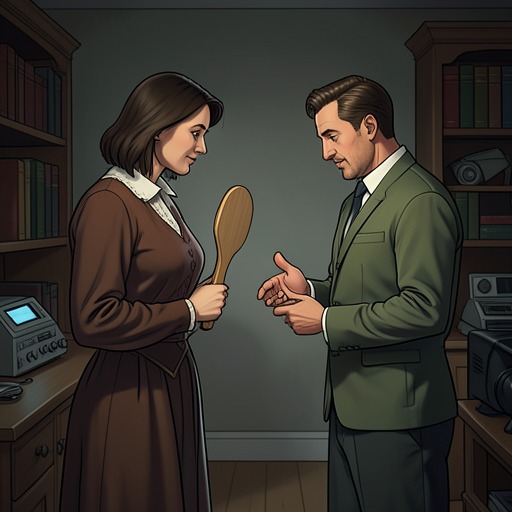
Their first sustained encounters therefore require Connie to present herself with controlled grace while carrying humiliation and desperation beneath it. When she sits before Warren Ryan, holding her handbag in her lap and trying to explain a proposal that sounds almost insane even to her, the contrast between outward poise and inward crisis establishes the emotional labor she brings into every new relationship. Blake McGrath initially offers an artistic opening rather than a romantic one: he agrees to exhibit his old paintings once Connie establishes her gallery, but warns her that the agreement has a condition.
That condition is the painting of Connie’s portrait. Blake McGrath proposes long days beginning early and continuing into the night, then offers her the spare room at his house so that the work will not be interrupted by travel. Connie accepts, but asks why he wants to paint again after so long and why he has chosen her. The invitation places them in sustained proximity, where professional collaboration, physical attraction, and the unspoken weight of their histories can no longer remain separate.
Intimacy and the House of Grief
Connie’s entry into Blake McGrath’s home also means entering the ritual world he has built around Chloe. At sunset, Blake McGrath and Ned go to the beach with a single red rose, a private practice repeated every day. The local fishermen call the house the “light house” because every light remains on day and night and can be seen for miles out to sea. Blake McGrath later explains that he keeps the lights burning so Chloe can find her way home. The house is therefore both a dwelling and a memorial mechanism: its illumination projects hope outward while revealing how completely grief governs domestic life.
Blake McGrath tells Connie that he and Ned send the rose into the sea and that Ned waits on the empty beach until sunrise, still waiting for Chloe. He has also added a raven-haired young woman to five paintings, imagining how Chloe might have looked if she had grown up and sending the works into the world so that she might one day recognize herself and know that she was remembered and loved. Connie does not merely learn a fact about Blake McGrath; she becomes a witness to an ongoing attachment that structures his art, his nights, his house, and his relationship with the ocean.
Their attraction emerges within that sadness but does not immediately override it. During the portrait sessions, Blake McGrath touches Connie’s cheek, recognizes desire in her eyes, and kisses her. The encounter is mutual and physically intense, yet Connie refuses to let their first sexual union occur in the still-haunted house. She tells him that she wants their first time to be a new moment, not happiness contaminated by the remnants of his sadness. Her restraint is not rejection. It is an attempt to protect intimacy from becoming an extension of mourning, and it marks one of the relationship’s central demands: Blake McGrath must make room for Connie without requiring her to disappear into Chloe’s absence.
Secrecy, Rupture, and the Demand for Truth
The relationship reaches its darkest point when Blake McGrath discovers Connie’s connection with Duncan Cartwright. He accuses her of having played him for a fool and retreats toward the studio, interpreting the concealed past as a betrayal of the trust he believed they were creating. Connie acknowledges that she should have told him about Duncan and about the past that shaped her, especially because Blake McGrath had shared his own tragedy with her. Her silence has not been equivalent to Duncan Cartwright’s coercion, but it has allowed the relationship to develop on incomplete knowledge, and the discovery reactivates Blake McGrath’s fear that intimacy brings deception and loss.
Connie answers the crisis by distinguishing what she wants from what Duncan Cartwright offered. She rejects the paintings as the foundation of their bond and tells Blake McGrath that she wants him. They move toward each other in the studio and cling together like survivors of a danger that has nearly destroyed them. After their reconciliation, they make an explicit vow: there will be no more secrets between them and no more hiding the truth from one another. The promise converts honesty from a moral abstraction into a condition of their partnership, joining emotional trust to the practical realities of Connie Dixon’s past and Blake McGrath’s grief.
The vow remains under pressure when Blake McGrath suddenly loses his sight. His blindness is experienced first as catastrophe and punishment. He crashes through the house, gropes toward the studio, and takes a cane from a spare-room closet, wielding it like a sword while asking why he has suffered enough. The cane, meant to support navigation, becomes in the crisis an instrument of rage; his body and the familiar house no longer cooperate. Connie watches helplessly as Blake McGrath stumbles away toward the beach, and the relationship is forced to confront not only his physical impairment but the despair through which he interprets it.
Blindness, Choice, and Reconciliation
On the beach, Blake McGrath tries to release Connie Dixon rather than allow her to remain from pity. He tells her that she can get away and begin her life again, insisting that he would hear pity in her voice and feel it whenever she looked at him. His fear is not simply abandonment. It is the belief that blindness has made him unworthy of an uncoerced future, and that Connie’s love might become another obligation imposed by suffering.
Connie refuses that definition of their relationship. She tells him that she does not want to live with a disabled man in his present emotional condition—not because he is blind, but because his heart is hollowed out by sadness, misery, and self-pity. Her distinction separates impairment from the grief that has become disabling. In relational terms, she refuses both to rescue him and to accept a partnership in which his mourning excludes her. She calls him back while leaving him responsible for choosing whether to return to life.
Blake McGrath eventually reaches for her hand. The physical contact becomes the hinge of their reconciliation: Connie does not guide him as a passive dependent, and he does not remain sealed inside the role of the tragic survivor. He realizes that her love is what he wants, while also understanding that he can remember Chloe without continuing to make grief his only identity. He tells Connie that he loves her, and she answers that she loves him with all her heart. Their reunion occurs amid seawater as the sun rises, turning the ocean that had once carried Chloe away into the setting for a renewed promise.
The relationship’s emotional resolution is completed through Blake McGrath’s farewell to Chloe. He kisses the red rose, throws it into the waves, and tells his daughter that she will always be loved and remembered. He declares that he cannot grieve any more and will instead celebrate her smile in sunshine and listen for her laughter on the wind. Connie waits for him on the porch, and they weep together before entering the house and turning off the lights one by one. The “light house” is no more, not because Chloe has been denied, but because Blake McGrath no longer needs the house to remain permanently lit as a signal for her return. His bond with Chloe is transformed from compulsive waiting into a memory that can coexist with Connie.
Shared Future and Artistic Renewal
The couple’s future becomes public through the opening of the Connie Dixon Gallery of Fine Art. Connie drives Blake McGrath to Hoyt Harbor, and he enters the gallery with his cane, moving slowly around the walls and counting paces to memorize the space while she handles practical problems with the catering staff. The scene makes their partnership concrete: Connie organizes the professional environment, while Blake McGrath adapts his body and spatial knowledge to participate in it rather than being excluded by blindness.
At the opening, Connie credits Blake McGrath with allowing her to show his lost works and his new portrait, thereby helping make her dream possible. Blake McGrath responds by crediting her love, laughter, passion, and persistence with lifting him from despair. He explains that he had thought blindness marked the end of his art career, and that he painted Connie’s portrait in search of redemption. He then announces that he will return to the easel, not to repeat his former seascapes or portraits, but to paint emotion.
This artistic decision gives the relationship a significance beyond romantic fulfillment. Blake McGrath says that he can no longer reproduce external scenes to his former standards, but that blindness may allow him to look inward and capture raw movement, color, love, loss, hope, and sadness without relying on visible images to intensify them. Connie Dixon’s presence does not replace art; it helps make renewed art possible. Their relationship thus moves from the private negotiation of grief and sexual trust to a shared public future in which her gallery provides a place for his transformed work, and his return to painting confirms that love has restored participation rather than merely offered consolation.